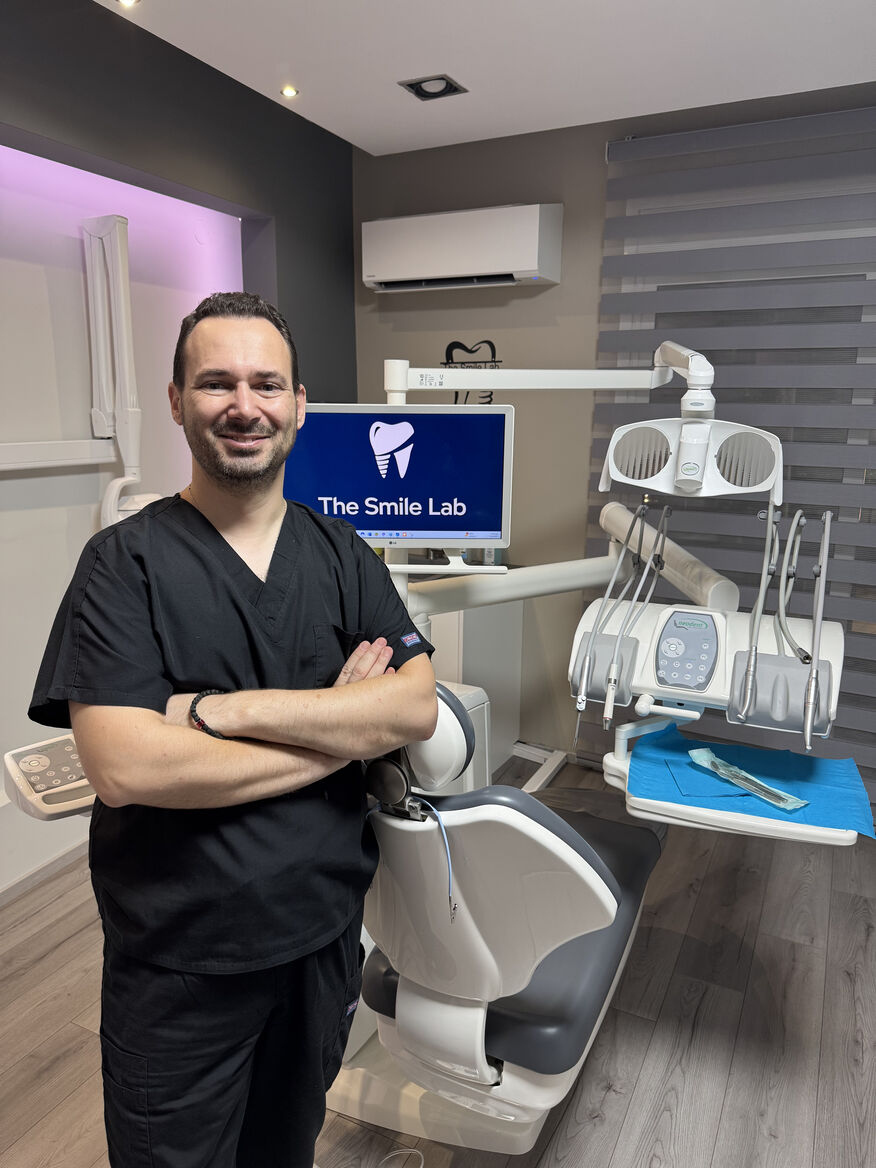
Dr Christos Koumlelis, our dentist, was born and raised in Thessaloniki, Greece. He graduated from the Aristotle University of Thessaloniki’s Dental School in 2006 and then served his national service in the Greek army with the designation of soldier/ dentist. A few months after his release, he opened his own practice in eastern Thessaloniki, where he worked continuously for nearly eight years.
During this time he was accepted into and successfully completed a three-year official postgraduate program at the Dental School of Thessaloniki (2011–2014). This program included both clinical and theoretical training in oral surgery, dental implants, and dental radiology. These postgraduate studies led to obtaining the title of specialist Oral Surgeon in Greece.
In late 2015 he moved to the United Kingdom, where he worked as an independent associate in private clinics in Glasgow (Scotland), Nottingham, Derby, and Ripley (Central England). He also attended multiple seminars for both theoretical and hands-on training across all areas of dentistry, with a particular focus on dental implants, prosthodontics, diagnostics in radiology and digital technology in dentistry.
In 2024 he returned to Greece and worked as an independent associate in a dental clinic in Rethymno, Crete. The following year he returned to Thessaloniki, his home city, and opened a new, upgraded dental practice.
With his extensive training and experience, Dr Koumlelis now treats patients with a wide range of dental issues, from routine preventive care to full oral rehabilitation. In every case he approaches each patient’s unique needs with respect and understanding, in a comfortable and friendly environment.
Every patient receives a thorough examination and diagnosis, along with a clear explanation of all available treatment options. We then carry out the chosen treatment plan with precision and attention to detail.
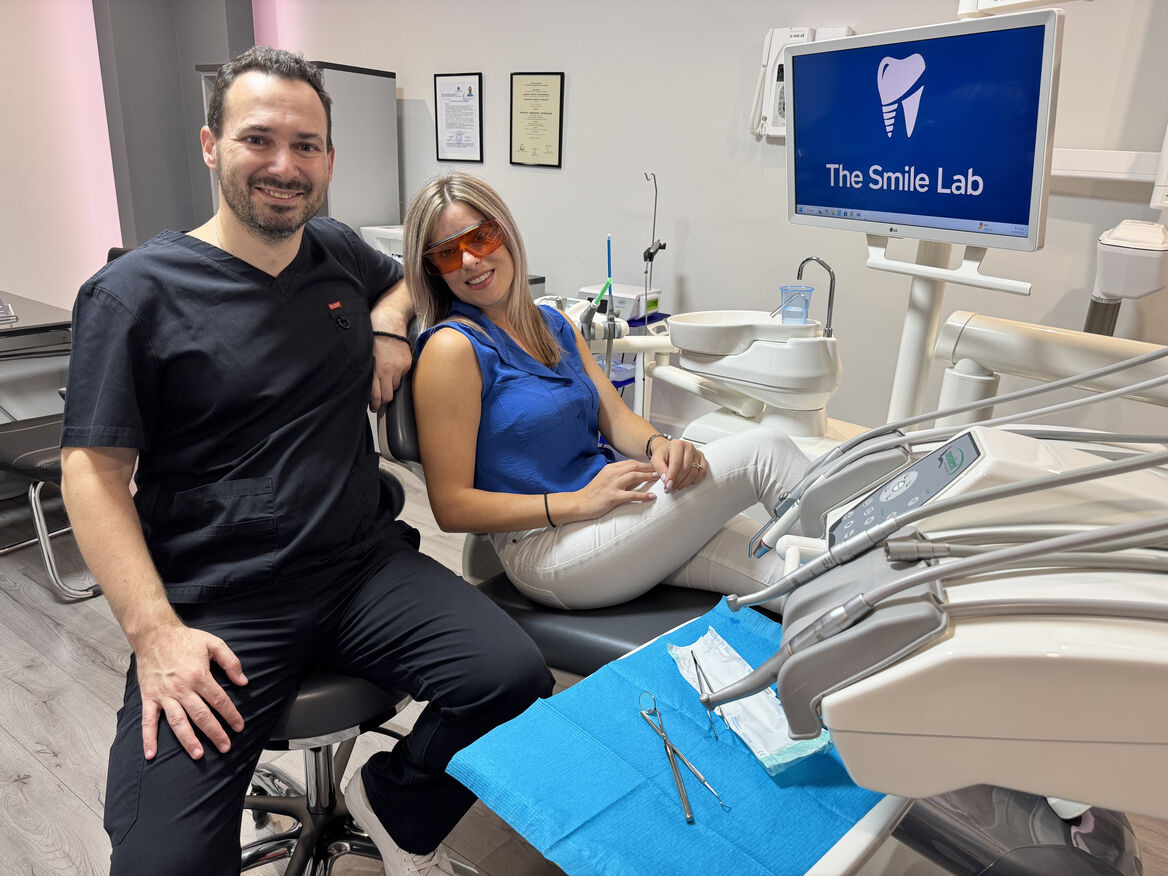
We treat each patient with empathy and care, ensuring they feel comfortable throughout every step of their visit and treatment.
Our dentist holds both undergraduate and postgraduate degrees of high caliber, an officially recognized dental specialty, and stays continually up-to-date by participating in seminars and conferences.
Dr Christos Koumlelis brings 18 years of substantial clinical experience across a wide range of cases in both Greece and the United Kingdom — a solid foundation for finding the right solution for your dental needs.
Oral Surgery deals with the treatment of pathologies and injuries of the oral cavity, such as tooth extractions, cysts, and implants. Its goal is to restore health and improve both the functionality and aesthetics of the mouth.
Oral Surgery began to take shape as a distinct field — a specialization within Dental Science — in the mid-19th century. This coincided with the establishment of independent university-level dental education, as well as the discoveries of anesthetics and X-rays.
Later, with the continuous expansion of the field during the 20th century, and especially with decisions made by European scientific bodies in the 1980s to gradually incorporate the requirement of a Medical degree into the dental specialization of “Oral Surgery,” the foundation was laid for the development of the specialty of “Oral and Maxillofacial Surgery.” This specialty addresses a wide range of pathological conditions in the oral, maxillofacial, and cervicofacial region.
As Emeritus Professor of Oral and Maxillofacial Surgery Ch. Martis characteristically notes in his book:
“In 1989, only within the European Union, Maxillofacial Surgery was institutionalized under the name ‘Oral and Maxillofacial Surgery’ and incorporated into the ‘European Union of Medical Specialists’ (U.E.M.S.) as a medical specialty. Entry into this specialty required possession of both Medical and Dental degrees and a five-year period of training and practice in the relevant fields. For the European Union, ‘Oral Surgery’ was also institutionalized, but purely as a dental specialty. In those countries that wished to establish it, it could exist either independently or alongside ‘Oral and Maxillofacial Surgery.’ However, its members were not permitted to practice the latter major specialty, since they were not physicians.”
Today, within the European Union and according to Directives 2001/19/EC and 2005/36/EC, the two have been defined as independent specializations: “Oral Surgery” within Dentistry, and “Oral and Maxillofacial Surgery” within Medicine. The latter, however, requires dual basic education — both Medicine and Dentistry (two degrees). According to these Directives, the specialty of Oral Surgery requires a degree in Dentistry and at least three years of full-time postgraduate theoretical and clinical training.
Oral Surgery is formally recognized as a dental specialty in 16 European countries (Bulgaria, France, Germany, Switzerland, United Kingdom, Ireland, Italy, Croatia, Cyprus, Lithuania, Malta, Hungary, Poland, Portugal, Romania, Slovenia). In most of these countries, “Oral and Maxillofacial Surgery” is also established as a separate medical specialty.
The field of Oral Surgery, as adopted by the Hellenic Society of Oral Surgery, is based on the report “Report and recommendations concerning competences for two specialist categories: Orthodontics and Oral Surgery”, which was voted on in 2001 in Brussels by the members of the Advisory Committee on the Training of Dental Practitioners of the European Council (EU document XV/E/8385/3/95-EN), and can be summarized and codified as follows:
Extractions of teeth (impacted or not) or residual roots, using closed or open (surgical) methods, as well as the management of possible complications, including oroantral communication.
Dentoalveolar surgery related to orthodontic treatment.
Periapical surgery.
Odontogenic and other surgical infections of the oral cavity.
Dentoalveolar trauma.
Preprosthetic, preimplant, and plastic surgery of the oral mucosa and the alveolar ridges.
Cystic or benign lesions of the oral mucosa and jaws.
Cystic or benign lesions of the minor salivary glands, as well as sialolithiasis of the excretory ducts of the major salivary glands.
Osseointegrated dental implants and guided bone regeneration techniques, including sinus floor elevation procedures.
Surgical management of dental patients with a compromised medical history.
Familiarity with the early diagnosis and appropriate referral of diseases, injuries, or abnormalities that extend to, or involve, the broader maxillofacial region and require complex surgical management by other medical or dental specialties.
Dental implants are artificial replacements for natural tooth roots, used when one or more teeth are missing. They can be described as metal screws — typically made of titanium — that are surgically placed into the jawbone under local anaesthesia. Once the implant integrates with the bone – a process known as osseointegration – artificial crowns, bridges, or dentures are attached to them, restoring function, aesthetics, and the patient’s quality of life.
Dr Christos Koumlelis holds an official specialty title in Oral Surgery from the Hellenic Dental Association, following the completion of a postgraduate program at the School of Dentistry of Aristotle University of Thessaloniki. For the past 12 years he has successfully handled numerous dental implant cases both in Greece and abroad.

At least twice a year for a routine check-up, even if you don’t have any symptoms or other evident problems. Many dental issues like cavities and gum disease progress silently at first. Regular check-ups allow early diagnosis, making treatment easier, faster and cheaper. Your dentist may recommend more frequent visits based on your needs. And of course, see your dentist promptly if you have discomfort or were advised to seek treatment.
The correct answer is whenever it’s needed. Statistically, however, most people will usually require professional cleaning of the teeth once or twice a year. This procedure removes plaque and tartar that brushing alone can’t. Sometimes even small amounts of build-up can irritate gums, so earlier cleanings can prevent more significant problems. Cleanings are often combined with your regular 6-month check-up.
At least twice a day – once in the morning and once before bedtime.
Ideally brush 30 minutes after meals, not immediately — especially after consuming acidic foods, as that can damage enamel.
Bedtime brushing is critical since saliva production drops while you sleep, leaving teeth more vulnerable to bacteria.

Your smile is your signature. We make sure it’s bright, healthy, and authentic just like you.